Off-By-One
Composer Duo
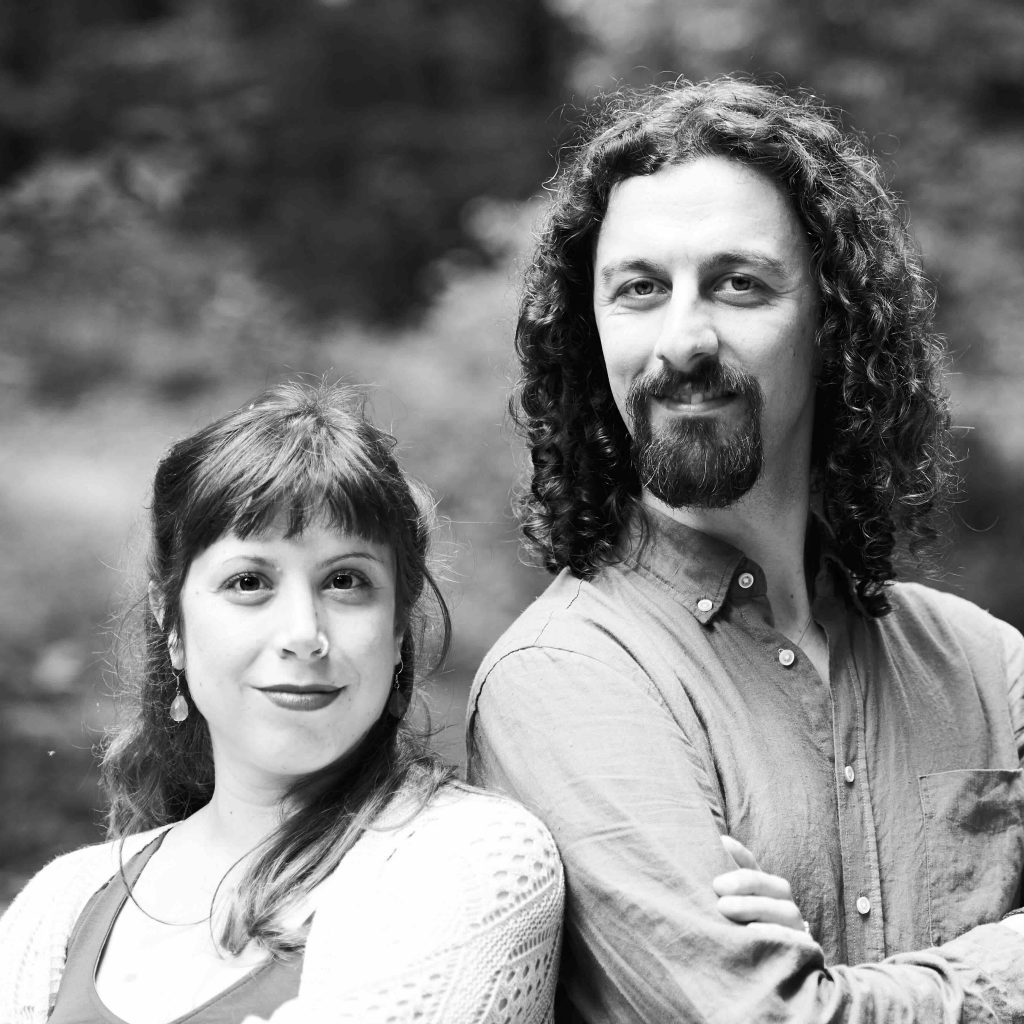
Laura Marconi and Gianluca Castelli are two Italian composers based in Düsseldorf, partners in both life and music. They created their first joint work in 2023: Bachs Engram – Variationen über das Gedächtnis, a piece that explores Bach’s original material through various memory processes and cognitive phenomena such as dreams, ear-worms, amnesia, and flashbacks. Their work is strongly influenced by an interest in a wide range of disciplines, including neurology, genetics, anthropology, and cosmology. Equally central to their artistic vision are questions of social justice and human rights, as reflected in their most recent project: a commission from the Rundfunkchor Berlin addressing the themes of fake news and propaganda.
Projects
Bachs Engram – Variationen über das Gedächtnis
8 Interludes to J.S. Bachs Orgelmesse (Dritter Teil der Clavierübung) for six female voices, small percussion and organ
Truth is
for mezzosoprano, choir, glasharmonica and piano
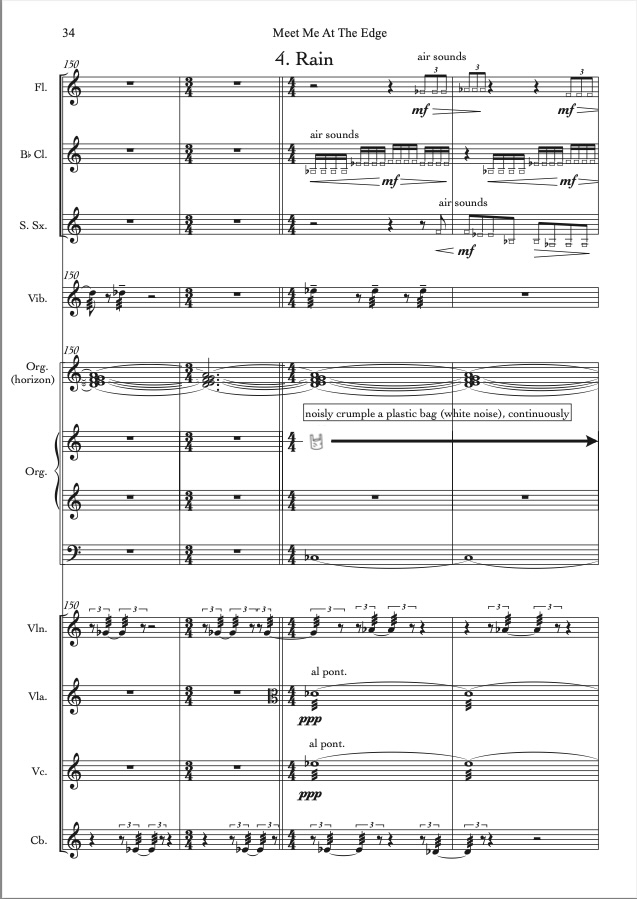
Meet Me at the Edge
For Organ and Ensemble
Bachs Engram – Variationen über das Gedächtnis
8 Interludes to J.S. Bachs Orgelmesse (Dritter Teil der Clavierübung) for six female voices, small percussion and organ
(2023)
Music: Laura Marconi, Gianluca Castelli
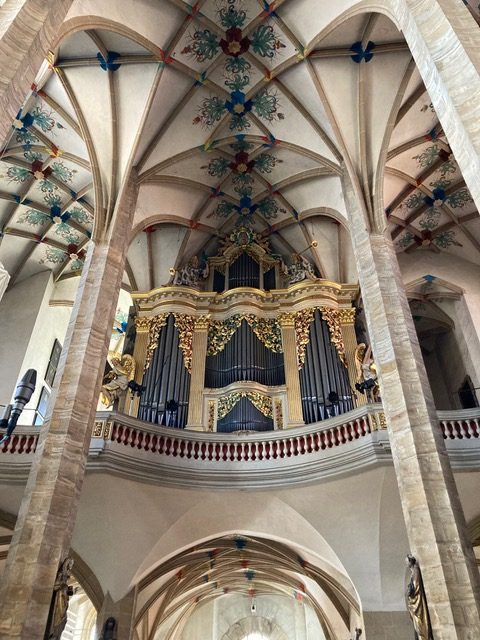
Premiere: 7 September 2023, Freiberger Dom, Germany
Texts from Bachs Chorals, The Brain by Emily Dickinson, Deus ti salvet by Bonaventura Licher
Commissioned by Freiberger Dommusik
Dedicated to and performed by Sjaella
Engram is a general term for a physiological trace that leaves behind a permanent structural change in the brain. The totality of all engrams results in what we call memory.
When Sjaella asked us (my wife, Laura Marconi, and me) to compose contemporary chorals to J.S.Bach’s Orgelmesse, we asked ourselves the following question: how can we create a connection to the past that is respectful, but also rich in new insights and relevant to our present?
For many years we have been interested in how human emotions, perception, memory and creation work. Therefore, we wanted to find a connection between the music of the past and our passion for how the brain works, which led us to the essays ‘ Searching for Memory ’ by Daniel L. Schacter, ‘ The Emotional Brain ’ by Joseph LeDoux and ‘ This is your brain on music ’ by Daniel Levitin, on which we partly based our work. Our music interweaves different ways of dealing with Bach’s original material, having being inspired by memory mechanisms such as dreams, ear-worms, amnesia and flashbacks.
Bach’s music emerges, disappears, is processed and associated with other elements, evokes old, forgotten melodies, emerges strongly again and then sinks into what we call the unconscious, or priming. A beautiful poem by Emily Dickinson, ‘ The Brain ’, is the subterranean stream of consciousness that holds the whole work together in a more or less obvious way. Only at the end does the text take full shape, manifesting itself in its entirety, but, thanks to the unconsciously acquired familiarity, we eventually recognize it as part of us.
We wanted to create a sound world where, through associations and reminiscences, the collective and individual experiences of Bach, Sjaella and ourselves intersect, a familiar and yet mysterious place where we can meet, question our perception and rediscover ourselves, where time is nothing but an impression.
I – The Brain [Laura]
to establish a durable memory, incoming information must be encoded much more thoroughly, or deeply, by associating it meaningfully with knowledge that already exists in memory.
This is known in the psychological literature as a “depht of processing” effect
Daniel L. Schacter, Searching for Memory
II – Ear-worm [Gianluca]
a piece of music that continuously occupies a person’s mind even after it is no longer being played
Daniel Levitin, This is your brain on music
III – Trauma [Laura]
tràuma [from Gr. τραῦμα (-ατος) “wound”]
In psychology and psychoanalysis, disturbance of the psychic state produced by an event endowed with considerable emotional charge. Serious alteration of the normal psychic state of an individual, consequent on sad, painful, negative experiences and facts, which disturb and disorientate
Dizionario Treccani
IV – Amnesia [Gianluca]
a medical condition in which somebody partly or completely loses their memory. In most cases, it is caused by a head trauma (brain damage) but it also can occur after a very traumatic event.
Nearly one in three people reported “memory difficulties” after a traumatic event, probably because they were so upset that they did not encode ongoing events normally
Oxford Dictionary
Daniel L. Schacter, Searching for Memory
IV.2 – Amnesia [Gianluca]
musician Clive Wearing, who was also a conductor, in 1985 contracted a viral infection that attacked his central nervous system and left him with what famed neurologist Oliver Sacks called “the most severe case of amnesia ever documented”. Unable to form any new memories that lasted longer than 30 seconds, Wearing became convinced every few minutes that he was fully conscious for the first time. Despite having no memory of specific musical pieces when they are mentioned by name and an extremely limited recall of his previous musical knowledge, Wearing remains capable of playing complex piano and organ pieces, sight-reading and conducting a choir
Lucy J. A. Kongola
Balaji Niwilikar
V – Flashback, Flash-forward [Laura]
Flashbacks sometimes contain elements of both real and feared or imagined events. [John MacCurdy] referred to such incidents as visions in order to reflect the mixture of fantasy and reality that they often contain. In psychology there are different opinions about how to recover from a traumatic experience. The healing process, although very personal, is generally divided into four main stages: acknowledgment, safety, processing, integrate
Daniel L. Schacter, Searching for Memory
Dr. Quincee Gideon
VI – Sleep – dreaming of memories [Gianluca]
memory processes have been shown to be stabilized and enhanced and memories better consolidated by nocturnal sleep and daytime naps
Wikipedia
VII – The one the other will absorb [Gianluca]
while conscious control over emotions is weak, emotions can flood consciousness.
This is is because the wiring of the brain at this point in our evolutionary history is such that connections from the emotional system to the cognitive system are stronger than connections from the cognitive system to the emotional system. Emotions easily bump mundane events out of awareness, but nonemotional events do not so easily displace emotions from the mental spotlight
Joseph LeDoux, The emotional brain
VIII – Awakening of an engram – the past within [Laura]
we now know enough about how memories are stored and retrieved to demolish another long-standing myth: that memories are passive or literal recordings of reality. Many of us still see our memories as a series of family pictures stored in the photo album of our minds. Yet it is now clear that we do not store judgement-free snapshots of our past experiences but rather hold on to the meaning, sense, and emotions these experiences provided us
Daniel L. Schacter, Searching for Memory
Truth is
for mezzosoprano, choir, glasharmonica and piano
(2026)
Music: Laura Marconi, Gianluca Castelli
Premiere: 23 April 2026, Heimathafen Neukölln Berlin, Germany
Commissioned by Rundfunkchor Berlin
This project seeks to follow several paths at once. On the one hand, it tells the story of Hessy Levinsons (see below), a striking example of a deep fake avant la lettre. On the other, it draws connections to a long history of political discourse surrounding immigration, deportation, and, more broadly, the construction of the “other” as a threat against which a supposed “we” must defend itself. This rhetoric of propaganda has echoed across centuries and national borders, often resurfacing in remarkably similar language. Words used today by Alternative für Deutschland to describe ostensibly harmless policies toward undocumented immigrants; words that Benjamin Franklin once employed when speaking—among others—about Germans themselves; words that now appear in official U.S. presidential documents; and words pushed to their most extreme conclusion in the “kill or be killed”scenario envisioned by Elon Musk. These expressions—ranging from subtle insinuations to overt claims—consistently appeal to people’s natural fear of the unfamiliar by exaggerating and often distorting information about immigration, using phrases such as “millions of illegal aliens,” “mass migration,” or underline that “they will never adopt our customs” (ignoring that customs are actually made of a mixture of cultural influences and are not immutable characteristics). These two dimensions—the personal and the collective—unfold simultaneously. While truth is denied and data manipulated, propaganda thrives on multiple levels. Lies generate further lies, flattening a reality that is rarely as simple as slogans suggest. Yet our minds are predisposed to accept such simplifications, conserving energy by embracing what appears clear and immediate. Truth, however, does exist, and eventually it will surface. But, as history repeatedly reminds us, when it does, it may already be too late.

Hessy Levinsons Taft was born on May 17, 1934, in Berlin, Germany. Because she was considered a very beautiful baby, her parents decided to have her photograph taken by a well-known photographer. Shortly afterward, the photographer was asked to submit his ten best baby photographs for a contest organized by the Nazis. Although he knew that Hessy was Jewish, he reportedly thought it would be “amusing” if the Nazis selected her photograph and therefore included it among the images he submitted. Not only did the photograph win the contest, but it was also published in a Nazi magazine and labeled as the “ideal Aryan baby.” As a result, the family was forced to leave Berlin quickly and flee to Paris, before moving through several other locations until they eventually managed to obtain visas for Cuba. In 1948, they immigrated to the United States and settled in New York. Hessy Levinsons Taft waited many years before publicly sharing her story and revealing the true identity of the baby in the photograph. She died on the first of January, 2026.
Meet Me at the Edge
For Organ and Ensemble
(2026)
Music: Laura Marconi, Gianluca Castelli
Premiere: 15 October 2026, Petruskirche Düsseldorf
Commissioned by IDO-Festival
The work of Japanese artist Chiharu Shiota, whose exhibition we saw in Turin in January 2026, served as the inspiration for this piece. The artist explains how clothes represent a “second skin” for her—one that retains a memory of the person who wore them—and how, in general, the boundaries we usually consider real—such as those between the inside and outside of our bodies, between the visible and the invisible, or between the microscopic and the macroscopic—are largely illusory. Similar reflections can also be found in Robert Wright’s book *Why Buddhism Is True*, where he discusses how pain—perceived as very real and “personal”—can, through the experience of meditation, come to be regarded as an event external to one’s body, just like the song of a bird or a bell ringing in the distance. We took these thoughts as our starting point for our third attempt to compose together—whatever “together” means. So this time we will start apart, separated by a note—a A-flat.
Gianluca will try to imagine the world above this horizon, while Laura will imagine the one underneath. Each of us will speak their own language, using different instruments—or different registers of the same instrument to form a specific shade. These two overlapping places will be the legs and wings of an enigmatic, chimerical being seeking to understand its still-fragmented nature. From this overlap will emerge a dialogue, an attempt at cohesion, a dance between the two souls that, though still separated by a well-defined line, seek to influence one another and unite. Can these turbulent forces bring down the wall that divides them? Can boundaries shift further forward even when it seems impossible to us—such as those between two minds—and crumble to create a middle ground, neither above nor below, neither inside nor outside, of same heart and mind? Will a new boundary still take shape afterwards, only to crumble and then form again and again, ad infinitum?